


The Role of Women in the History of Rope Making
The history of rope and cordage manufacturing is not only a story of machinery and physical labor, but also one of resilience, precision, and female ingenuity. Although collective imagination often associates this trade with masculine strength and port life, women played a central role in the production of ropes and nets long before the Industrial Revolution.
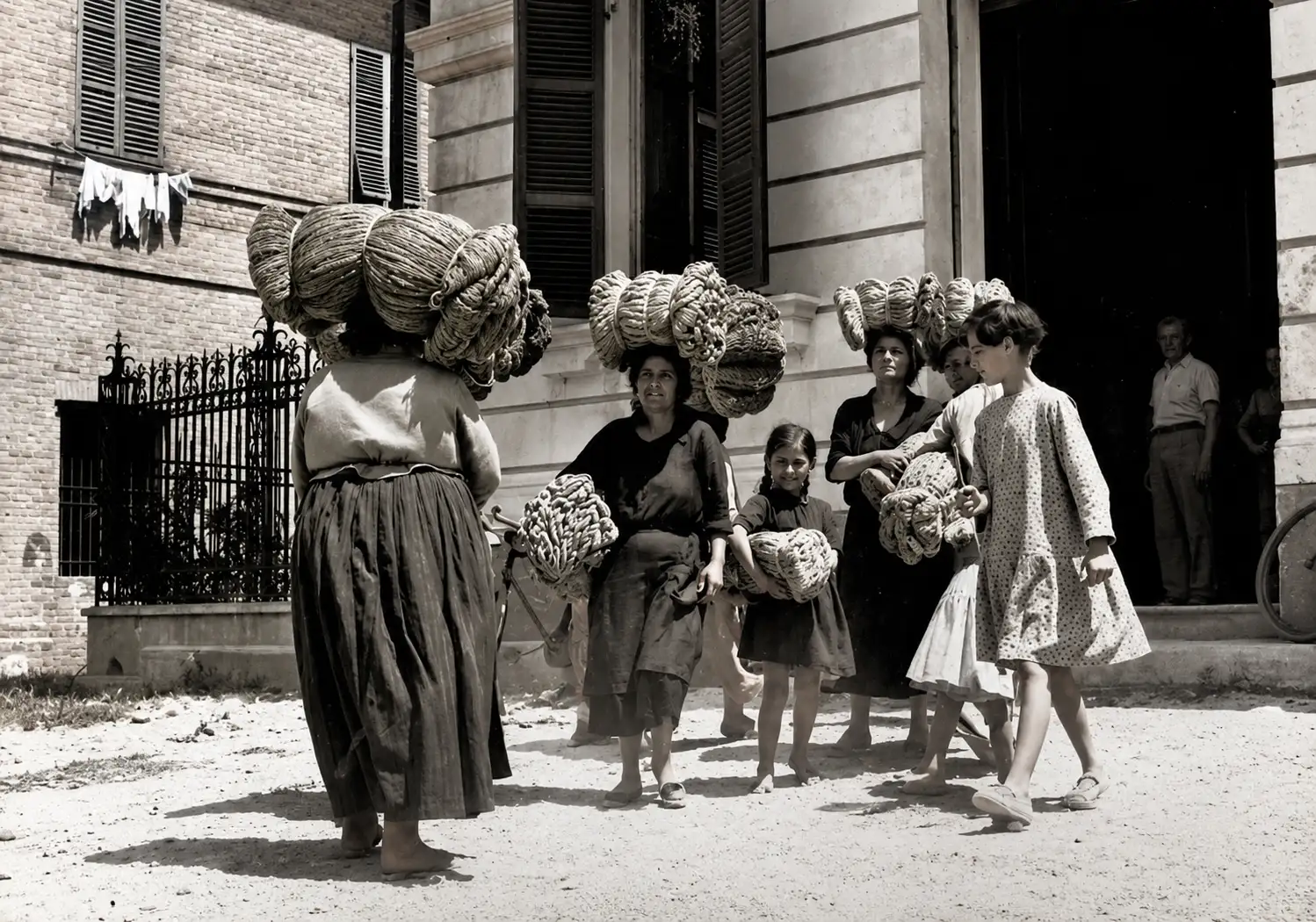
Women in the History of Rope Making
Women Entrepreneurs
Even in the pre-industrial era, many women managed independent manufacturing businesses, demonstrating remarkable entrepreneurial skills. Among the Women Master Ropemakers, figures such as Helen Lindsay stand out, who in 1851 in Edinburgh managed a business employing men and apprentices, as well as Isabella Rolland, who firmly and successfully ran the company she inherited from her husband.
These women were pioneers of a phenomenon that would later become widespread: by 1923, nearly two-thirds of the workforce in the rope-making industry in the United Kingdom were women.1
The Atmosphere of the Factories: The Face of Women Workers
Imagine stepping into a rope factory in the early twentieth century. The air is thick with the sharp scent of hemp and the rhythmic noise of machinery. Here, rows of women — the true workers behind rope production — dominated the scene. They were not mere spectators, but the backbone of the industry.
They could be seen bent over enormous pulleys, eyes fixed on the tension of the yarn, or carefully operating twisting frames with millimetric precision. Their hands were marked by hard work, yet moved with the agility of a musician, guiding needles at astonishing speed.
They were mothers, daughters, and sisters who, inside vast industrial halls, transformed raw fiber into ropes strong enough to support entire ships, ensuring the quality of every knot and twist.2
The Heart of San Benedetto: The Tradition of the Retare
Within this international context, the history of San Benedetto del Tronto also holds a special place. Before becoming Eurofuni, Rosetti Giuseppe e Figli worked daily alongside the Retare, women specialized in the production and repair of fishing nets.
The Retare would visit the company warehouses to collect raw hemp and then, from their homes or along the streets of the town, transform the fiber into fishing nets using techniques passed down through generations. Once completed, the nets were returned to the warehouses in exchange for the agreed payment.
It was an economy built on trust, craftsmanship, and female artisanal knowledge. Even today, this memory is preserved through the historical tools of the Retare displayed at the Sea Museum.3
From the Knot to the Bit
There is an invisible thread connecting the hands of the Retare and rope makers to modern processors. Historians of technology highlight how the mathematical skills required for weaving and knotting laid the foundations for computational logic.4
- Binary Language: the concept of the “knot” (over/under, full/empty) anticipated the binary structure (0/1).
- Weaving Algorithms: the creation of complex nets required rigorous logical patterns, true ancestors of modern algorithms.
- Millimetric Precision: managing tensions and patterns in rope factories anticipated the extreme accuracy later required by the first computers.
From the factories of Belfast to the streets of San Benedetto, women did not simply produce ropes and nets; they quietly and concretely helped weave the foundations of the modern world, transforming a practical necessity into a science of precision — a legacy that Eurofuni is committed to honoring every day.
Notes
1. Celebrating Female Ropemakers in Maritime History
2. Ancient Female Trades: Women and the Sea